Why does the inequality sign change when both sides are multiplied or divided by a negative number you ask? The answer is quite simple. The purpose of an inequality is to state that one number is less than (or greater than) another. Now, picture a number line like this: 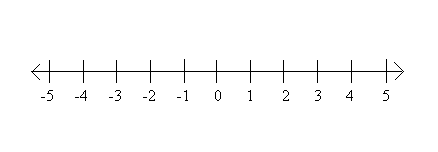 Now lets use 2 as an example.
When you multiply or divide any number other than zero by a negative, its sign will change. If it was positive it becomes negative and if it was negative it becomes positive. So positive 2 divided by lets say -1, will now give you -2. Well now instead of being on the right sign of the number line the number "flips" and is on the left.
When you multiply or divide both sides of an inequality this happens as well.Both sides "flip" making a number that used to be positive, now negative or vise-versa. So a number can go from being REALLY BIG to teeny tiny.
What was less than before is now greater than. This, my children, is why we have to flip the sign whenever we multiply or divide by a negative number. Flipping the sign keeps the inequality making sense.
|
Saturday, October 20, 2012
What's the point of flipping an inequality symbol?

Subscribe to:
Post Comments (Atom)
No comments:
Post a Comment