Sunday, December 16, 2012

How do we simplify radical expressions?

           Radicals are by far the scariest looking thing ever. Seriously I mean look at this for example, √18xy⁴z . How the heck do you solve that? Well I'm here to help you. Lets take this one step at a time. First step ignore the radical it makes your life easier. Even though 18 is not a perfect square, it can be broken down into smaller pieces where one of those pieces might be perfect square. From 18 we can say 9 and 2 multiply to give you 18 and 9 is a perfect square. From x we get x and x. We leave y alone because its already "perfect" . And z is all alone so it just stays z
       So now under the Radical we have √9•2x⁴•x•y•z. Now we begin to just pull out the perfect parts we take out nine and that turns into a 3 outside of the radical. We can't do anything with two so it stays inside. x⁴ comes out as x² and the single x stays inside. With y⁴ we bring it out and it turns into y² with no y's inside. Lastly x was all alone and it remains that way inside the radical. 
        Now we just take our perfect outside piece, 3x²y² and combine it with what stayed in our radical √2xz and our final answer is 3x²y²√2xz. Suddenly simplifying these radicals seems like a breeze! All we did was this:                   
           Not that hard huh?

Sunday, December 9, 2012

How do you factor a trinomial where a>1 ?

                    Factoring by grouping was simple to understand but, what if now you get a trinomial that looks like: 6x2+19x+10? In this case factoring by grouping will not work but there is a way to factor this easier than you would expect.
            First you take your a and your c, in this case 6 and 10, and multiply them together giving you 60. Now you will find two numbers that multiply to give you your product of a and c and add to give you b. So were looking for two numbers that multiply to give you 60 and add to give you 19. If you guessed 15 and 4, you got it!
          Now you take these two numbers and replace them in your old equation. Your new equation will look like: 6x2+15x+4x+10. Now what do you do? Well now you can factor by grouping. You know the drill, Take the first two terms and the last two terms and pull out the greatest common factor. The GCF of the first two terms is 3x and the GCF of the last two terms is 2. So currently you have 3x(     )+2(     ).
                 You'll bring down what you have left which will be 2x+5 in both equations. Now that they have something in common you combine both 2x+5's and combine the two GCF's leaving you with a final answer of (3x+2)(2x+5). Bing bang bomb you factored that dude. 

Sunday, December 2, 2012

How do you factor by grouping?

            You're taking a test and you're doing great all of a sudden you get to a question that says Factor: 2x3+4x+5x+10. In your head you think "crap" but have no fear! I'm hear to show you how it's done! 

       First split up the expression into two parts. The first two and the last two. Deal with both parts alone. Now working with the first part pull out the GCF. The GCF of 2x3+4xis 2x2 now you bring down whats left which is (x+2). When you put that all together what you get for the first half is        2x(x+2).

         Now you do the same thing to the second half of the expression. Pulling out the GCF of 5x+10 gives you 5. Pulling out whats left is going to give you (x+2). Notice that after taking out the GCF both half's of the equation have the same thing left over. Now you combine everything for the second half givig you 5(x+2)
          
        You have now factored both half's of the equation and its time to bring it all to together. right now your parts look like 2x2(x+2)+5(x+2). (x+2) is common on both sides so you can combine that. Now you combine both GCF's and your final answer looks like (2x2+5)(x+2). Now you can finish your test without losing your mind.

Sunday, November 18, 2012

How do we solve quadratic inequalities graphically?

              In Algebra I we learned how to solve linear inequalities both algebraically and graphically. Now in Algebra II we take this concept and apply it to solving quadratic inequalities. Let's solve the quadratic inequalities x2 + 4 < 0. First we factor so that we can find where the parabola crosses the x axis and that looks like this: 
x2 + 4 = 0 
x2 – 4 = 0 
(x + 2)(x – 2) = 0 
x = –2  or  x = 2 
            Now that we know the roots are -2 and 2 we can plot those points. Because its a negative inequality we know the parabola opens down. We can plug in numbers to the equation to find other points to plot and in the end we'll have this: 
                      To solve the inequality we need to find out which points where the graph is below the axis or in other words where the y - values are less than zero. To find where we need to shade we can pick a test point inside or outside of the parabola and the one that's true indicates where we need to shade. In this case we shade outside of the parabola leaving your graph to look something like this: 
               And our final written solution is x < –2 or x > 2.


Sunday, November 11, 2012

How do you solve a quadratic by completing the square?

                Ahh quadratics! They suck and we all hate them but, we still have to solve them. Instead of suffering through that long quadratic formula way of solving them I present you with an easier, simpler, and faster way of solving most quadratic equations. This method would be solving quadratics by completing the square. Now you start off with a simple quadratic such as: 
                                                         4x2 – 2x – 5 = 0
           Now instinct would tell you oh plug it all in but no. Instead you add 5 to the other side of the equation. I know this is completely different then what you're used to, but trust me on this. After adding five you're left with 
                                                              4x2 – 2x = 5
                  Now there are a few steps you have to do now. First you have to get rid of the four so that there is no coefficient in front of the squared term. Now after that you divide the second term by 2 and then square it. Whatever you get you add it to both sides.That was a lot of information, but this is how you do it.  
               
                                          
                 See not that hard? Now you have completed the square but your answer isn't finished. Now you take the square root of both sides of the equation.
                           
                                           
                   You're almost done now! All that;s left is solving for X. The change to the plus or minus symbol signifies that you will have two answers. Remember quadratics are square because you have two answers. 
                                                       
                  You're final answer looks something like:
  
                                           
                   See not so bad huh? It takes some getting used to but once you master these steps you'll be solving quadratics by completing the square all the time. Unless of course you love that quadratic formula.

Saturday, October 27, 2012

How do we use imaginary numbers?

               When using the quadratic formula to solve quadratic equations we sometimes run into problems. When finding the discriminant (b²-4ac) that number can come out to be negative. Here's an example:
      How are you supposed to find the square root of -4? Impossible, right? You may be thinking "Oh. There must be no solution." But there is and using imaginary numbers you can find that solution. An imaginary number is represented by i ,and will help you find your answer. i is the answer to the √-1. This allows us to find the square root of a negative number. Hurray! Lets apply this to √-4.
     First we get rid of the √-1 from √-4 this will leave you with i√4. Getting the gist? The problem becomes a breeze from here. Because you know 4 is a perfect square you just simplify and get 2. Don't forget about your imaginary component. The i goes after all real numbers, and before square roots. Making your final answer 2i. Piece of cake huh? That my children, is how you use imaginary numbers when solving a quadratic equation. 

Saturday, October 20, 2012

What's the point of flipping an inequality symbol?

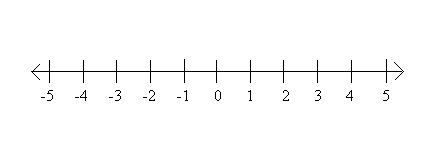
          Why does the inequality sign change when both sides are multiplied or divided by a negative number you ask? The answer is quite simple. The purpose of an inequality is to state that one number is less than (or greater than) another. Now, picture a number line like this: 
            Now lets use 2 as an example. 
When you multiply or divide any number other than zero by a negative, its sign will change. If it was positive it becomes negative and if it was negative it becomes positive. So positive 2 divided by lets say -1, will now give you -2. Well now instead of being on the right sign of the number line the number "flips" and is on the left.
       

       When you multiply or divide both sides of an inequality this happens as well.Both sides "flip" making a number that used to be positive, now negative or vise-versa. So a number can go from being REALLY BIG to teeny tiny.
What was less than before is now greater than. This, my children, is why we have to flip the sign whenever we multiply or divide by a negative number. Flipping the sign keeps the inequality making sense.